
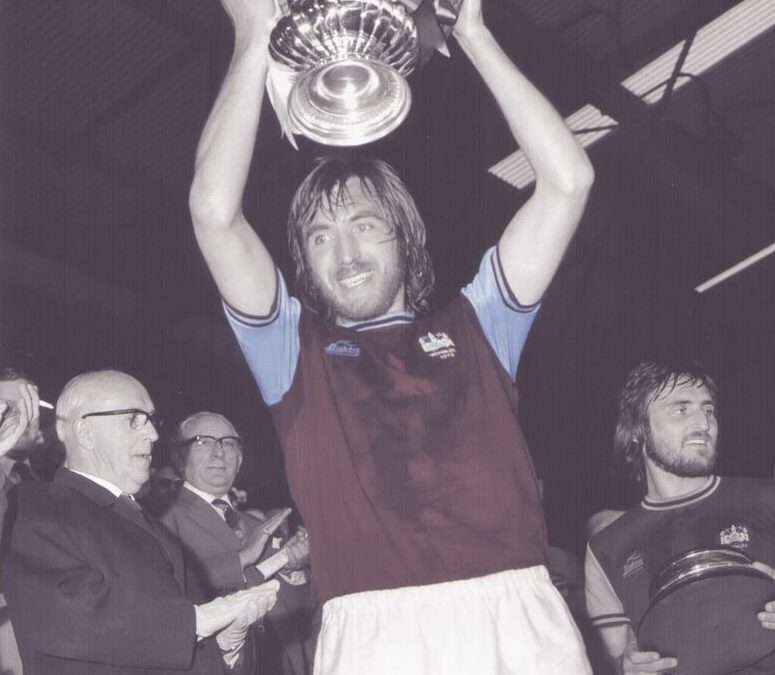
By Vince Cooper
The 1974-75 season saw a tight and exciting tussle for the First Division title. At the end of the campaign five points covered the top seven clubs. But it was Derby County, led by first-season manager Dave Mackay, who took the crown. The Rams finished two points clear of both Liverpool and Ipswich Town (the Reds finished second on goal average although had it been goal difference Ipswich would have claimed the runners-up spot). The trio were closely followed by Everton, Stoke City, Sheffield United and Middlesbrough.
Champs Derby County
But none of that septet would contest the F. A. Cup final. It was a pair of London teams who took the field at Wembley with 13th-placed West Ham United being joined by Second Division also-rans Fulham who had finished in 9th place in the second tier and who included in their ranks the Hammers’ greatest-ever player.
The 48 Football League Divisions Three and Four clubs joined 32 Non-Leaguers to do battle in the first round proper in November 1974. These teams were whittled down and in January 1975 those left standing joined the First and Second in the 64-team 3rd Round.
There were a quintet of non-leaguers still in the hat and they acquitted themselves well. Stafford Rangers drew at home with 4th Division Rotherham United but the Northern Premier League side then travelled to Millmoor and shocked their opponents recording a 2-0 win thanks to goals from Stuart Chapman and Mick Cullerton.
Another Northern Premier League side, Altrincham, travelled to Goodison Park and grabbed a deserved 1-1 draw with Everton. The visitors took the lead through the prolific John Hughes and then, before half-time Toffees winger Gary Jones was sent off for punching an opponent and even worse was to follow when John Connolly suffered a broken leg. The second half though, saw the 10 men battle back and captain Dave Clements saved Everton’s blushes with an equaliser 20 minutes from time.
The replay was switched to Old Trafford where a crowd of over 35,000 saw goals from Mick Lyons and Bob Latchford ensure a relieved Toffees made it through to the 4th Round.
Wycombe Wanderers also managed a draw with 1st Division opposition as their home encounter with Middlesbrough finished goalless. The replay at Ayresome Park attracted a crowd of 30,000 who saw the top flight team snatch a 1-0 win thanks to a late David Armstrong strike which came after a through ball from Graeme Souness.
The Leatherhead Lip puts Brighton out
Isthmian Leaguers Leatherhead United had already seen off league opponents in the 2nd round when beating Colchester United. They added another scalp in round three when they travelled to Brighton’s Goldstone Ground and dumped out their 3rd Division opponents – managed by Peter Taylor – with a goal from Chris Kelly, the mercurial striker who earned the nickname ‘The Leatherhead Lip’ thanks to his bold predictions.
Perhaps the biggest shock on a day of major surprises came at Turf Moor. Southern League Wimbledon had beaten Bath City and Kettering Town to earn a crack at the big boys but now they faced a fine Burnley side who would end the season in 10th place in the top flight.
Wimbledon, with goalkeeper Dickie Guy in outstanding form, withstood early pressure and gradually grew into the game. Just after half-time Ian Cook broke clear. His shot was parried and Micky Mahon pounced to score the rebound. After going behind the Clarets pressed even harder but Guy and the Dons defence held out to record a famous victory, and the first by a non-league team against one from the top flight since 1920. Their reward? We’ll get to that.
Neither of the eventual finalists had it easy in Round Three. West Ham United travelled to The Dell to face a tricky tie against a Southampton team that would win the competition a year later. Goals from Frank Lampard and Bobby Gould proved enough to see the Hammers home 2-1 with Mick Channon scoring for Saints.
Alan Slough (second from right) scores Fulham’s winner against Hull City
Fulham played fellow second tier team Hull City and the sides played out a pair of draws before the Londoners finally made it through at the third time of asking, winning 1-0 at Filbert Street thanks to an Alan Slough goal.
There was also a difficult passage for London giants Arsenal who needed extra time and a hat trick from Brian Kidd to see off York City at Bootham Crescent after a 1-1 draw at Highbury
In the 4th Round, the three non-league survivors all fell by the wayside, but not without a fight. Stafford Rangers switched their game against Peterborough United to Stoke City’’s Victoria Ground and were rewarded with a crowd of 31,160. Sadly they lost out to Posh 2-1
Leatherhead were given a home draw against Leicester City but they switched the match to the 1st Division club’s Filbert Street Ground. The non-leaguers were full of confidence, or at least Chris Kelly was. ‘The Leatherhead Lip’ famously said; “Leicester are rubbish. We’ll stuff them”.
The Tanners looked like fulfilling Kelly’s prediction when they raced into a 2-0 lead thanks to goals from Peter McGillicuddy and the Lip himself. Kelly had another effort cleared off the line to stop Leatherhead going 3-0 up and from there, the Foxes fought back.
A Jon Sammels header halved the deficit. Soon after, Tanners’ ‘keeper John Swannell made an excellent save from Keith Weller but he then failed to hold on to a Frank Worthington free-kick and Steve Earle prodded home the equaliser. Worthington then set-up Weller to score the winner and Leatherhead’s brave fight was over (although with receipts from a 32,000 crowd to console them).
That left Wimbledon and a daunting trip to Elland Road to take on mighty Leeds United.
And what a trip it was. Goalkeeper Guy followed up his outstanding display against Burnley and was, if anything, even better against a star-studded Leeds team.who had endured a traumatic start to the season with the hiring and firing of Brian Clough. 46,230 fans were at Elland Road and nobody present could have predicted beforehand that they wouldn’t see a goal.
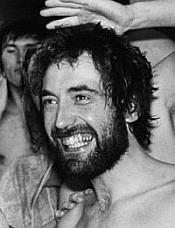
Dons hero Dickie Guy
That fans had no goals to enjoy was thanks in huge part to Guy. He was superlative throughout and, with six minutes remaining, surpassed himself by saving a Peter Lorimer penalty helping his team hold out for a highly improbable goalless draw.
Wimbledon switched the home replay to Selhurst Park and another 45,000+ crowd attended. The Dons again proved a match for the side that would go on to contest the European Cup final before being finally undone by a Dave Bassett own-goal.
Both Fulham and West Ham again faced difficulties before progressing to the 5th round. As if the three games in the previous round weren’t enough Fulham went one ‘better’ as it took them four matches to get past Brian Clough’s Nottingham Forest. The Cottagers had goalkeeper Peter Mellor to thank for a goalless draw at Craven Cottage then, at the City Ground John Dowie gave Fulham the lead before Neil Martin squared things up.
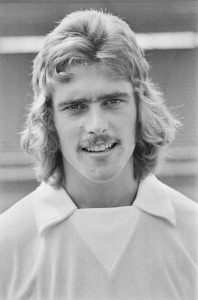
Busby’s brace won the day – twice
It was back to Craven Cottage for a second replay, another 1-1 draw before the Londoners finally came out on top at the fourth time of asking when they visited the City Ground for a second time and a brace from Viv Busby proved decisive.
West Ham needed ‘just’ the one replay to overcome Swindon Town, securing a 2-1 win at The County Ground after a 1-1 draw at home.
The 5th round saw both eventual finalists enjoy relatively smooth passages both coming through at the first time of asking. Fulham travelled to Goodison Park and saw off top-flight Everton 2-1. Again it was Busby who proved the difference-maker scoring the opener and then finding the winner after Roger Kenyon had equalised for the home team. West Ham got the better of Queen’s Park Rangers in a London Derby 2-1 with Keith Robson and Pat Holland scoring the goals.
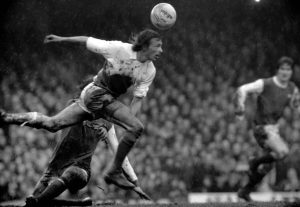
Alan Taylor. Two goals in quagmire conditions
The Hammers were given another all-London clash in the quarter-final and this time it was a trip to North London to play Arsenal. A crowd of 56,472 were present and saw Alan Taylor score twice in quagmire conditions to secure a semi-final spot for his team.
Taylor was playing just his fifth game for the club after joining from Rochdale for £40,000 at the end of 1974. He was fortunate to have missed his previous team’s early FA Cup rounds having been injured towards the end of his time at Spotland and was therefore not Cup-tied.
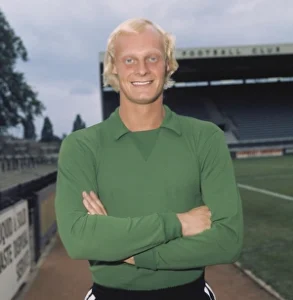
Fulham hero Peter Mellor
Fulham’s quarter-final tie gave them a long trip to Carlisle where they took on a team enjoying a brief stay in the top flight. A Les Barrett strike after 66 minutes escaped home ‘keeper Alan Ross and provided the only goal. The Cottagers again had their own ‘keeper, Mellor, to thank after another superlative display.
Mellor had signed for the club in 1972 after starting his career at Burnley where he was a regular before being displaced by Alan Stevenson. Alec Stock paid £25,000 for the former England under-23 shot-stopper and he would go on to make over 200 appearances for the club before leaving for Hereford United in 1977. He finished his English career at Portsmouth before moving to Canada to play for Edmonton Drillers.
In the other quarter-finals Ipswich Town got the better of Leeds United 3-2 thanks to goals from BryanHamilton, Trevor Whymark and Clive Woods in a second replay at neutral Filbert Street and Birmingham City overcame Middlesbrough thanks to a Bob Hatton goal to complete the semi-final line-up.
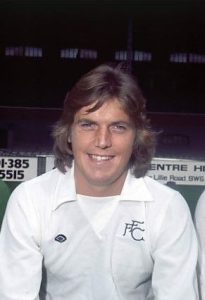
John Mitchell. Semi-final hero
Both of the semi-finals went to a replay. Fulham took the lead against Birmingham City at Hillsborough through John Mitchell but Joe Gallagher levelled things up. The teams met again at Maine Road and Mitchell scored again, this time in the 119th minute with a shot that rebounded off the keeper, hit him and rolled in to send the West Londoners through to their first-ever F.A. Cup Final.
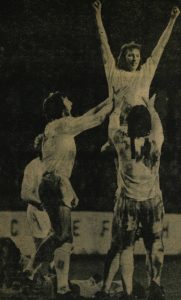
Alan Taylor is hoisted high after grabbing the winner
West Ham and Ipswich fought out at goalless draw at Villa Park in front of 58,000 and when the teams met again, this time at Stamford Bridge, the Londoners fell behind after just two minutes when Billy Jennings put through his own net. Again it was Taylor who proved the hero scoring twice to help the Hammers turn things around and send them to Wembley.
Fulham had taken a record 11 games to reach Wembley and had been drawn away initially in every round. Their opponents had taken a ‘mere’ seven. On the league front it was a poor campaign for both teams with both seeming to reserve their best performances for the cup.
The opposing managers on the big day were at opposite ends of the experience scale from a managerial perspective although neither had a playing career of note.
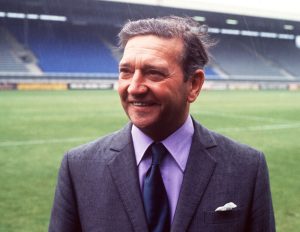
Alec Stock
Alec Stock’s career on the pitch just seemed to be getting going at Queen’s Park Rangers when World War Two came along. By the time hostilities had ceased the playing window was closing and he moved into non-league football with Yeovil Town where he also took over as manager.
In 1949 Stock led Yeovil on a cup giant-killing run that included victory over Sunderland before being ended in the 5th Round by Manchester United. He then spent a decade at the helm of Leyton Orient. In the late 1950s then a year at the helm of A.S Roma before returning to England.
In 1959 Stock took over as manager of former club QPR and he led the then 3rd Division club, to a famous League Cup triumph in 1967, overcoming West Bromwich Albion 3-2 after being two down. He was fired by Chairman Jim Gregory at a time when he was absent through illness and he then moved on to Luton Town before joining Fulham in 1972.
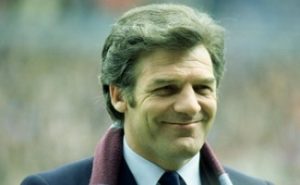
John Lyall
Having been a youth international with West Ham, John Lyall’s career was forced into a premature end when he suffered a serious knee injury and had to retire aged just 23.
Lyall was given the role of part-time youth team manager, which was then upgraded to full-time. He then made his way through the ranks before taking over as first-team boss from Ron Greenwood at the start of the 1974-75 season. He finished his first season leading his team out at Wembley and would remain at the helm for 15 years before being sacked in 1989 after a total of 34 years at the club.
The finalists had ‘form’ that season despite competing in different divisions and Fulham had come out on top, winning 2-1 when the two met in a Football League Cup 3rd round tie back in October.
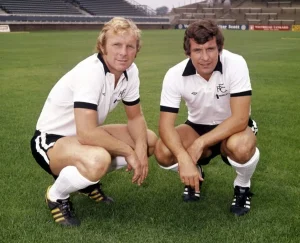
Bobby Moore and Alan Mullery
The Fulham team contained two former England captains in Bobby Moore and Alan Mullery and, of course, Moore had skippered West Ham for many years including leading them to F.A. Cup glory in 1964. Skippering the Hammers now was Billy Bonds.
Moore had left Upton Park for Craven Cottage in March 1974 for £25,000. This was after the Hammers had rejected a joint bid of £400,000 in 1973 for Moore and Trevor Brooking from Nottingham Forest’s Brian Clough.
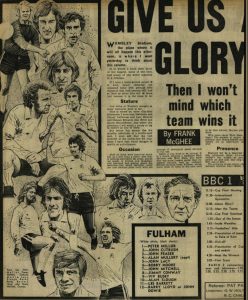
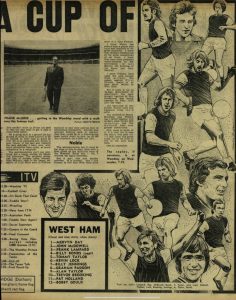
Daily Mirror 3 May 1975
Fulham’s final line-up was missing Les Strong after the full-back was injured against Portsmouth shortly before the final giving reserve John Fraser an opportunity. Hammers boss Lyall preferred Taylor to Bobby Gould up front, leaving the more experienced man on the bench in favour of the player in form.
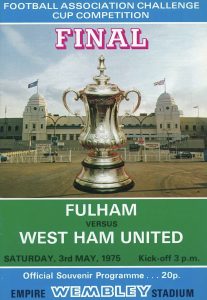
Fulham, who had the makers marks on their boots blacked out after a sponsorship row, started the brighter of the two, although caution was paramount in the first period. West Ham goalkeeper Mervyn Day – at 19 the youngest player in his position to start in a final – comfortably held the West Londoners at bay with a John Lacey header which missed the target the closest either team came to scoring early on.
As the first period wore on, the East Londoners started to get on top and one superb ball from Brooking gave Jennings a half chance to test Mellor. The Fulham goalkeeper had already looked shaky on a couple of occasions but this time he held on well.
In the second period the Hammers began to press home their superiority although Mitchell had a half chance that, again, Day saved well. Soon after, at the other end, John Cutbush gave up possession to Jennings who shot. Mellor parried the ball but it fell to Taylor who drilled it back towards goal, and between the keeper’s legs to give his team the lead.
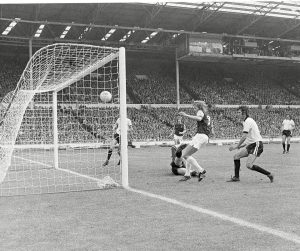
Taylor pounces to double the Hammers lead
Within four minutes West Ham had doubled their andvantage and again it was Taylor who capitalised on another Mellor mistake after the keeper had failed to hold on to a long range effort from Graham Paddon. The striker chipped the ball home to complete a remarkable record. Having scored two in the quarter-final and two more in the semi he completed a brace of braces.
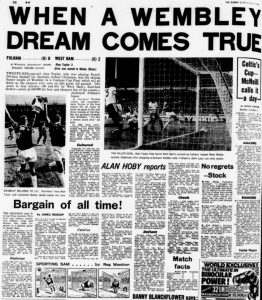
Sunday Express 4 May 1975
Fulham had a couple of chances to get back into the game but Day proved up to the task of keeping a clean sheet and by the time referee Pat Partridge blew for full time his team were well on top. The only blemish on West Ham’s day was that they were unable to complete the customary lap of honour due to over-exuberance from their fans who spilled over onto the track surrounding the pitch.
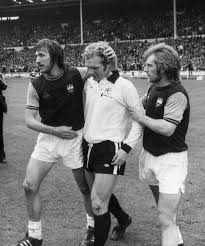
Billy Bonds and Graham Paddon console Bobby Moore
It was to be Moore’s final appearance at Wembley. Although he continued with Fulham for a further two years they never came close again to the Twin Towers. Some of the West Ham team, with Bonds again leading them, would be back for another Cup Final, appearance five years later when Brooking’s header proved decisive against Arsenal.
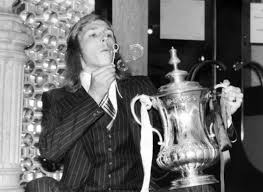
Alan Taylor: Blowing bubbles
So a long and incident-packed 94th F.A. Cup came to an end. It was a tournament notable for the arrival of the crazy gang, for the success of the East Enders and for the final appearance beneath the Twin Towers, of English football’s golden boy.