
BY Vince Cooper
As we all know, loyalty is a rare commodity in football these days. Nobody can criticise players for making the most of what is a short career and when offers are on the table the most sensible thing to do it to take the biggest one. There are exceptions to this rule of course with the likes of Paul Scholes and John Terry springing to mind from recent times. But how about spending not just your entire football career with one club but your whole working life? Here’s the story of a man who did just that.
William Isiah Bassett was born on 27 January 1869 in West Bromwich. He was the oldest of six children and his dad was a coal merchant. Billy’s footballing life started with local amateur teams but his talents soon came to the attention of West Bromwich Albion and he signed for the club in 1886, the season in which they reached the first of three successive F. A. Cup finals, losing to Blackburn Rovers in a replay.
Bassett could play either inside or outside-right but would eventually settle on the wing. Only 5ft 5in tall, he was speedy, played with a directness that unnerved opposing full and half-backs and was said many times to be capable of ‘electrifying the crowd’.. In his second season with the (then) Stoney Lane club they reached a second successive F. A. Cup final but lost again, this time to Aston Villa.
Having broken into the first team during the 1887-88 campaign Billy featured prominently in the run to a third successive final and he was in the line up at Kennington Oval as Albion took on the all-conquering Preston North End in front of a sold out crowd of 17,000.
The match was expected to produce a great clash of styles with underdogs West Brom, a team of locals known for their typically English long-ball game up against a predominantly Scottish Preston side, on an amazing run of 43 consecutive victories who played in the short-passing style which dominated the game north of the border.
Albion came out on top, winning 2-1 and Bassett, who set up the first goal for Jem Bayliss, was generally considered to be man of the match, although the game wasn’t without its controversy. North End’s star forward John Goodall (English although his father was a Scot and he was raised in Kilmarnock) recalled many years later that he stood dumbfounded in the centre circle at the final whistle.
Goodall, along with many observers, was shocked at a number of the decisions made by referee Major Francis Marindin. Indeed, another famous footballer, Nottingham Forest’s Tinsley Lindley, commented that Preston had played ‘against 11 men and the devil’.
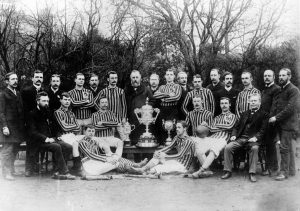
F. A. Cup winners 1888
Within weeks of the cup victory Bassett was rewarded with his first cap, playing in the 5-1 win over Ireland in Belfast and, in doing so at just 19 he became, at the time, the youngest player to play for England.
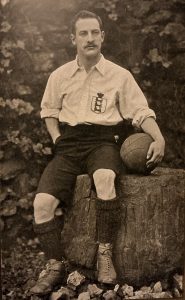
Bassett of England
1888-89 was the inaugural season of the Football League and West Brom were widely expected to figure prominently. But it was Preston who stormed to the title going unbeaten and recording 18 wins from their 22 matches.
Albion finished in mid-table 18 points off the pace and also lost their hold on the F. A. Cup when beaten by – who else? – Preston at Bramall Lane in the semi-final. North End would go on to complete the double with a 3-0 victory over Wolves at The Oval.
Bassett continued to perform at the highest level and was rewarded with further England caps including eight against the ‘Auld Enemy’ among his total of 16 with six goals. He was also part of the F. A. squad that visited Austria and Germany in 1899. England played four matches in six days beating the Germans three times by an aggregate score of 30-4 and also hammering Austria 8-0.
At club level, Bassett remained a key part of the Albion line-up throughout the last decade of the 19th century.
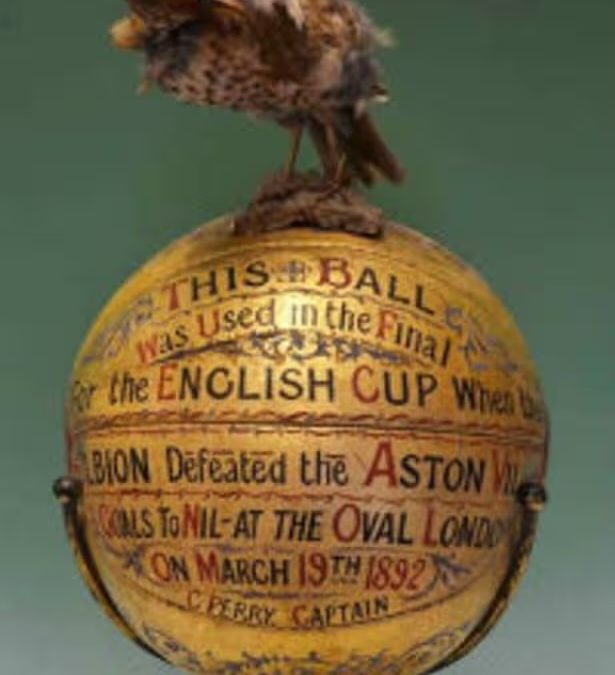
Whilst the Baggies were little more than an average league side during this period they were certainly a force to be reckoned with in the cup. A further run to the final came in 1892 when Old Westminsters, Blackburn Rovers, The Wednesday and Nottingham Forest were seen off to set up a final clash with local rivals Aston Villa.
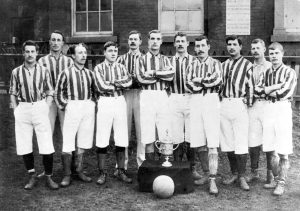
Cup winners again
Villa, coming off a 12-2 thumping of Accrington a week before were heavily favoured against an Albion side which had struggled in the league all season and who had suffered 5-1 and 3-0 defeats to their rivals earlier in the season.
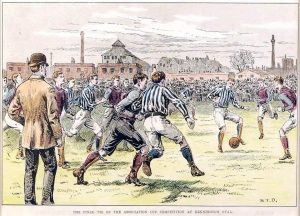
Action at the Oval
But it would appear that the adage about league form going out of the window in cup competition has a long history as Bassett and his teammates ran out comfortable 3-0 victors thanks to goals from Alfred Geddes, Sammy Nicholls and Jack Reynolds in front of a crowd of almost 33,000.
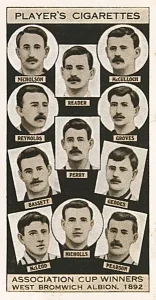
The winning XI
This was to be the final major club honour of Bassett’s career, although Albion came close to another cup victory in 1895 when Villa got their revenge in the final. He carried on playing for the Throstles until retiring in 1899 – despite rumours at one stage that he might be moving to Everton – and finished with 311 competitive starts for the club.
The only blemish on his playing record came on 28th April 1894. With their league season over Albion travelled to London to meet Millwall in a friendly. Although the result of the match is now lost in the mists of time what is known is that Billy was sent off for ‘the use of unparliamentary language’ a phrase which leaves little to the imagination.
So, in 1899 the Bassett football-playing life ended but for Billy, in many ways life was just getting started.
In June 1900 he married Beatrice Birch and the couple would go on to have four children, a boy and three girls. The Barretts took over a pub, The Anchor Inn in West Bromwich before later moving to take on the Dartmouth Hotel.
As well as working as a football journalist Billy remained closely involved in Albion and in 1905 he played a major role in saving the club from extinction.
The club opened their new stadium The Hawthorns in 1900 but immediately suffered relegation from the First Division and attendances tumbled. When the bank served a writ in 1905 the board of directors resigned. Former chairman Harry Keys returned and brought Bassett with him. Together the pair organised fund-raising activities to reduce the debt and saved the club from being wound up.
Three years later Billy took over as chairman and in 1910 he stepped up again, helping the cash-strapped club Bynumpaying the players’ summer wages out of his own pocket.
Albion eventually regained their place among football’s elite and in 1919-20 they won their first – and still only – title.
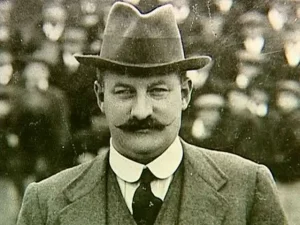
Chairman Billy
Fast forward to 1931 and a young Albion side made up mostly of homegrown youngsters reached their seventh F. A. Cup final and first at Wembley and it was Bassett who proudly led the team out Wembley. He then proudly looked on as his team took the trophy for the third time.
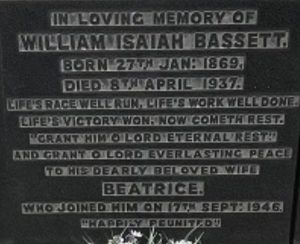
Billy Bassett’s 51-year association with his beloved club ended when he passed away aged 68 in 1937 just days before Albion played old foes Preston at Highbury in the F. A. Cup semi-final. A period of perfectly observed silence was held before the teams kicked off with West Brom fans remembering – no doubt fondly – a man whose own interpretation of one-club loyalty will probably never be surpassed.
Screenshot